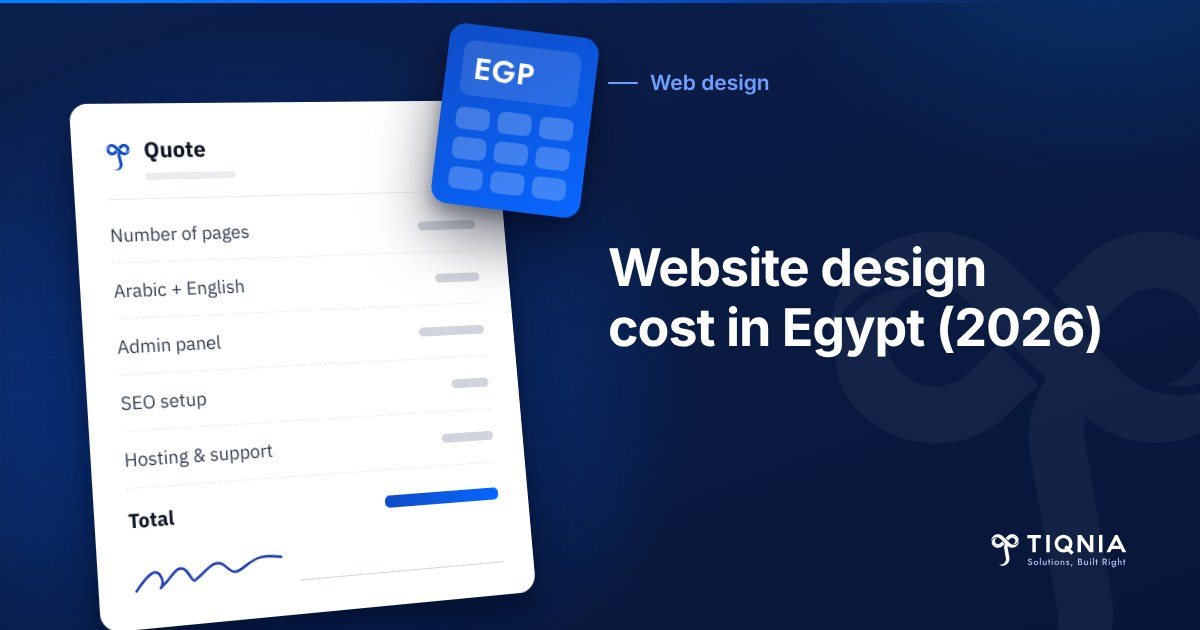
If you are budgeting for a company site, here is the short answer: website design cost in Egypt in 2026 starts at roughly EGP 2,000 for template-based offers, begins around EGP 20,000 for a small 5–10 page company site according to GoDaddy's regional estimates, and goes past EGP 100,000 once you add custom design and integrations. The spread is wide, but it is not random.
Most quotes give you one number and very little about what it buys. That is why two agencies can quote EGP 5,000 and EGP 60,000 for what sounds like the same "website", and you are left with no fair way to compare them.
Below are the published market figures with their sources, the factors that move the price, the yearly and hidden costs people forget, realistic timelines and payment terms, and a list of questions to ask any vendor before you sign.
The short version, if you are in a hurry:
- Template offers start around EGP 2,000; a small company site starts around EGP 20,000. Rough figures that move with the exchange rate.
- The biggest cost drivers are integrations, custom design and a second language with its own copy.
- Budget for two years (domain, hosting, email, maintenance), not just the handover price.
- Compare quotes on written scope: pages, revision rounds, ownership and support.
- The domain must be registered in your company's name, whatever the price.
What is the website design cost in Egypt in 2026?
There is no single price for a company website in Egypt, but the market falls into three tiers. These figures were reviewed in November 2026; they are rough and vary with size, languages, features and who builds the site:
- Template site: published offers start around EGP 2,000 for a 5-page site with basic hosting and reach about EGP 6,000 with a control panel and domain, according to offers compiled by Almaal (updated October 2026). Fine as a starting point, usually without a distinct identity.
- Small to mid-size company site (5–10 pages): from about EGP 20,000, and up to about EGP 120,000 for a medium site with a store, per GoDaddy's 2026 Middle East website cost guide. The same guide puts a basic site in Saudi Arabia at roughly SAR 1,500–3,000.
- Large or fully custom corporate site: regional pricing guides put corporate sites at $4,000–15,000, noting some Arab markets run 30–40% lower, per StudyShoot's website pricing guide (updated August 2026).
You will also find foreign guides that price even a "simple website" in Egypt in the hundreds of thousands of pounds. Those numbers are based on international development teams and much larger projects, so they are not a realistic benchmark for a typical company site in the local market.
All of these figures move with the exchange rate, because a real share of the cost (hosting, themes, plugins, tools) is paid in dollars. Treat any number you read today as a snapshot.
Why do website prices in Egypt vary so much?
Website prices vary because buyers are not comparing the same product: they are paying for hours of work, a level of skill, and responsibility after launch. A EGP 3,000 quote and a EGP 50,000 quote usually describe two different things under the same name.
- Who builds it. A solo freelancer or a team with a designer, developer and project manager. Median rates for web designers on Upwork are $15–30 an hour, according to Upwork's cost guide; an agency adds management, testing and support on top.
- How much work is actually in scope. Custom design, copywriting, an English version, an admin panel, forms connected to email or a CRM. Each line is hours.
- What happens after launch. Some quotes end on handover day; others include support, updates and renewals. It shows in the price, and it shows even more when the site goes down.
So compare scope with scope, not number with number. To see what a complete company website usually includes, read how we build company websites at TIQNIA and hold any quote up against it.
Still choosing who should build it? Here are 7 questions to ask any web design company before you pay.
What drives the cost of a company website?
Seven factors drive the cost of a company website, and they fall into three groups. A serious quote should be explicit about each one; if a factor is missing, ask before you assume it is included.
Size and content
- Number and type of pages. An About page is not a detailed service page, and neither is a 200-product catalogue. The type matters more than the count.
- Languages. Arabic plus English is not "just translation": it means right-to-left and left-to-right layouts, two sets of copy, and SEO for each language.
- Content. Who writes the copy and prepares the images? Copywriting alone is priced at $50–200 per page in market guides such as StudyShoot.
Design and platform
- Template or custom design. Templates are faster and cheaper; custom design builds your identity around your own users.
- Admin panel. Can your team edit text, images and news themselves, or does every change go through a developer?
Integrations and operations
- Features and integrations. Quote forms, booking, WhatsApp, payment gateways, links to accounting software or a CRM. Integrations are among the most expensive items because they need the most testing.
- SEO and speed groundwork. Heading structure, clean URLs, a sitemap and mobile speed. Google uses the mobile version of a site for indexing and ranking, so a site that is weak on mobile starts behind.
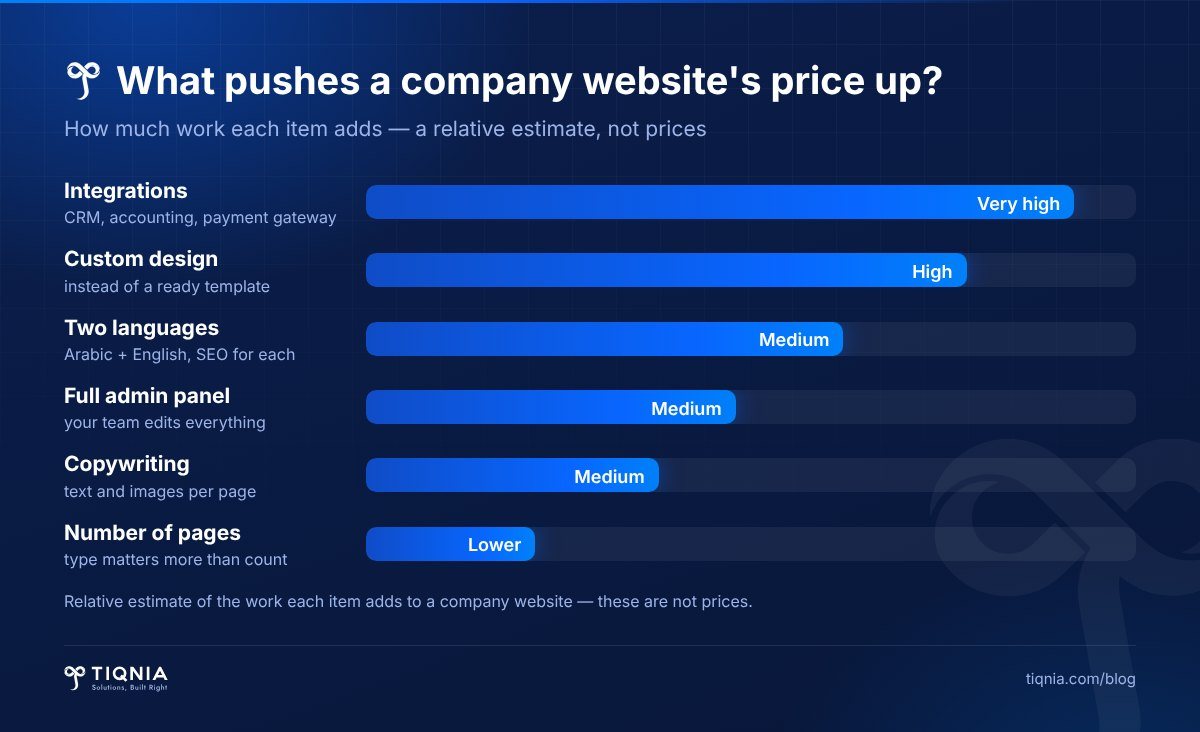
These factors do not carry equal weight. The chart below shows their rough order by how much work, and therefore cost, each one adds:
WordPress or custom code: how the platform changes the price
The platform a site is built on affects both the build price and what you pay afterwards. Most company sites in Egypt are built on WordPress or with custom code (for example Laravel), and each choice has its logic.
- Static site: fixed pages with no admin panel. The cheapest option, but every change needs a developer.
- Dynamic site on WordPress: a ready admin panel and a large plugin ecosystem, so the build is faster. Watch for premium theme and plugin licences, some of which renew every year in dollars.
- Custom code: suits sites with real business logic (bookings, a client portal, a link to an internal system). It costs more upfront, but there are no recurring plugin licences and it grows on your terms.
The right question is not "which is cheaper?" but "which will serve my business for three years without a rebuild?". A brochure site for a services company is usually fine on WordPress; a site that talks to company systems usually needs custom code.
Template or custom design: which one fits your company?
A template fits a company that needs a quick, low-budget presence online; custom design fits a company whose website has to sell and build trust with larger clients.
A template makes sense if:
- You need a small site quickly.
- You do not mind looking like many other sites.
- The website is not your main source of new clients.
Custom design makes sense if:
- You sell to companies or clients who compare you with competitors before calling.
- You have several services or products and want a clear path to a quote request.
- You need Arabic and English at the same quality, or links to your existing systems.
There is a middle path too: a template customised to your brand. StudyShoot puts customised templates at $500–2,000, a sensible option when you need a professional look without a full design budget.
Freelancer, agency or do it yourself?
The choice between the three comes down to how much responsibility you want someone to carry with you, not just price. Each route has a visible cost and a hidden one paid in your own time.
Do it yourself on a site builder
Builders such as Wix charge a monthly subscription, roughly EGP 400–550 a month in Egypt according to GoDaddy. The real cost is your time: design, content and SEO are all on you, and the site is not fully yours if you ever want to move it.
Hire a freelancer
Usually cheaper and fine for simple sites. The risk is that everything depends on one person: if they get busy or disappear after handover, support stops. If you go this way, collect every login and the code from day one.
Work with a web design agency
More expensive upfront, but you get a project manager, testing, post-launch support and contractual responsibility. It fits when the website is part of your sales and your image in front of larger clients.
Yearly and hidden costs: what you pay after launch
A company website has recurring yearly costs beyond the build: mainly the domain, hosting, business email and maintenance. If a quote does not separate these, ask.
- Domain: your address, such as company.com. A .com runs about EGP 500–800 ($10–15) a year, per GoDaddy. More important than the price: it must be registered in your company's name.
- Hosting: where the site runs. Shared hosting is about EGP 150 a month and cloud hosting starts around EGP 900, per the same source.
- Business email: name@company.com. Services such as Google Workspace charge per user per month in dollars, and many hosting plans include email.
- SSL certificate: the padlock in the browser. Free certificates exist; paid ones suit sensitive sites.
- Maintenance and support: security updates, backups and fixes. Market guides such as StudyShoot put maintenance contracts at $100–300 a month. This is the line that separates a site still working in two years from one that quietly breaks.
And some costs people only discover later:
- Renewal prices are higher than year one: cheap domain and hosting deals often apply to the first year only.
- Theme and plugin licences: some are yearly subscriptions billed in dollars.
- VAT in Saudi Arabia: 15% on the invoice, per GoDaddy, so budget for it if your company is based there.
- Out-of-scope changes: any new page or feature after sign-off is billed separately, so keep a buffer.
A simple formula helps: two-year cost = build + content + (domain + hosting + email + maintenance) × 2 + a buffer for changes. The quote that looks cheapest today can turn out to be the most expensive over two years.
How long does a company website take, and how is it paid?
Timelines depend on the size of the site and how fast the content is ready, more than on anything else. A template brochure site can be done in weeks; a custom bilingual site with integrations can take a few months.
The most common cause of delay is not development but content: copy, images and logos that are late on the client's side. Prepare content early, or agree that the vendor writes it.
For payment, the healthy structure is a few stages tied to clear deliverables:
- A deposit at signing to start the work.
- A payment after the design is approved.
- The final payment after launch and the full handover of logins.
If a vendor asks for the full amount upfront with no stages and no written delivery date, that alone is a reason to stop and ask questions.
How to compare website design quotes
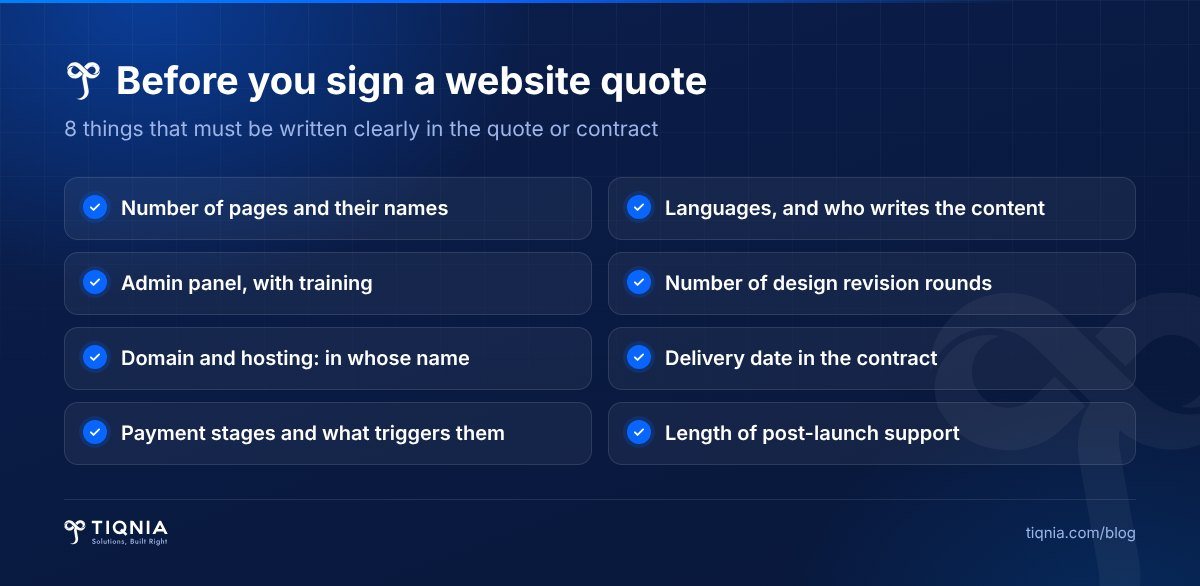
Compare quotes on written scope, not on the final number. The checklist below shows what must be clear before you sign:
Eight questions every quote should answer
- How many pages exactly, and which ones?
- How many languages, and who writes or translates the content?
- Is there an admin panel you can use yourself, and training on it?
- How many design revision rounds?
- Are domain, hosting and email included, for how long, and in whose name?
- Is the delivery date written into the contract?
- How many payment stages, and what triggers each one?
- How long is post-launch support, and what does it cover?
Red flags in a very cheap quote
- The domain will be registered in the vendor's name "to make things easier".
- No fixed page count and no number of revision rounds.
- No admin panel, or one you will never get the logins for.
- No mention of support after launch.
How to save without losing quality
- Start with the pages that actually bring clients, and leave the rest for a second phase.
- Prepare copy and images in-house if your team can.
- Use a customised template instead of full custom design if the site is not your main sales channel.
- Do not cut hosting or support: they protect everything else you paid for.
How TIQNIA scopes a company website
At TIQNIA, a Dokki-based technology partner working with companies in Egypt and Saudi Arabia for over 9 years and more than 350 delivered companies, we do not put a number down before we understand the need. The process is fixed: discover, define, design, build, test and launch, then operate and improve.
About 300 clients renew their hosting, domain and support with us every year. That keeps reminding us that the real question for any company is not only the handover price, but what it will pay, and who it will be able to call, in year two and three. Ask that question of every quote, ours included.
To make comparison fair, every company website proposal from us spells out:
- Arabic and English versions, with a full admin panel and training.
- A first design concept plus 3 revision rounds.
- A delivery date written into the contract, with payment in 3 stages.
- 6 months of support after launch, plus domain, hosting and business email for the first year.
- A named project manager and a written update every week.
You can browse our portfolio of corporate sites such as Retal, Arch Builders and Pharma Treat, read the details of our company website service, or see what our after-launch support covers. And honestly: if the lowest price matters most to you, we are probably not the right fit.
Have a quote in front of you and not sure it covers everything? Message us on WhatsApp at +20 101 768 6542 with the line items, and we will tell you what is missing.
The bottom line
A company website in Egypt can cost anywhere from a few thousand pounds for a template to tens of thousands for a custom bilingual site with an admin panel and support. The right number for your company comes from a written scope and a two-year view, not a market average.
If you want a proposal built on what you actually need, tell us what you need or send us a WhatsApp message and we will come back with a clear scope.
FAQs
How much does a company website cost in Egypt in 2026?
Based on published market figures, template offers start around EGP 2,000, a small 5–10 page company site is about EGP 20,000 according to GoDaddy, and custom bilingual sites with integrations go past EGP 100,000. These are rough figures that move with the exchange rate.
Are domain and hosting included in the website price?
Not always. Some quotes include domain, hosting and email for the first year only; others exclude them entirely. Ask how long they are covered and confirm the domain is registered in your company's name.
What increases the cost of a company website the most?
The biggest cost drivers are custom design instead of a template, a second language with its own copy, a full admin panel, and integrations with payment gateways, accounting software or a CRM.
What are the yearly costs of a company website?
Recurring costs are domain renewal, hosting, business email, a paid SSL certificate if needed, and maintenance and support. Budget for the first two years together before deciding.
Should I hire a freelancer or an agency for a company website?
A freelancer is usually cheaper and fine for simple sites; an agency adds project management, testing, post-launch support and contractual responsibility. Compare scope and support, not just the price.
How long does it take to build a company website in Egypt?
It depends on the site's size and how ready the content is. A template brochure site can take a few weeks; a custom bilingual site with integrations can take a few months. Late content from the client side is the most common cause of delay.
Is WordPress cheaper than a custom-coded website?
WordPress is usually faster and cheaper to build because the admin panel is ready, but some themes and plugins carry yearly dollar licences. Custom code costs more upfront and suits sites with real business logic or integrations with company systems.
Tell us what you need and the TIQNIA team will come back with a clear plan.